
Krinkov itself began life in the Soviet Union during the turbulent 1970s. In 1973, Soviet military planners, amid their shift from the 7.62x39mm AKM to the new 5.45x39mm AK-74 family, initiated a design competition codenamed “Modern” for a compact, fully automatic carbine suited for vehicle crews, airborne troops, and special forces. Legendary designer Mikhail Kalashnikov entered with a shortened version of his AKS-74, drawing inspiration from earlier prototypes like Peter Tkachev’s AO-46. After rigorous testing by airborne divisions in the Transcaucasian Military District, Kalashnikov’s design emerged victorious in 1977 and was officially adopted in 1979 under the GRAU index 6P26 — the AKS-74U, with “U” standing for “Ukorochenniy” or “shortened.” Production ran from 1979 to 1993 at the Tula Arms Plant, not Izhmash, churning out these ultra-compact beasts: 206.5mm barrel, overall length of 490mm folded, weighing just 2.7kg, and firing at 700 rounds per minute with a distinctive muzzle booster that amplified gas operation while creating a massive blast.

The nickname “Krinkov” didn’t come from Russian roots — despite myths of it mimicking the “krink krink” sound of full-auto fire. Instead, it traces back to Pashtun dialects in eastern Afghanistan and Pakistan during the 1980s Soviet-Afghan War. Mujahideen fighters, capturing these rarities from downed Soviet helicopters and armored vehicles, adapted “Kalashnikov” into local pronunciations like “Krinkof,” “Shrinkov,” or “Shesakov,” adding a Pashtu twist to Russian-ize the word and elevate it as a symbol of bravery and prestige. The AKS-74U was prized loot, often from elite Spetsnaz or VDV units, and became a status item among Pashtuns — even appearing with figures like Osama bin Laden in the 1990s. The term entered Western awareness through a 1984 Soldier of Fortune article by David Isby, who heard it from Afghans in Pakistan, and it stuck when the first AKS-74U parts kits hit U.S. shores in the early 1990s. American builders, like Paul Mahoney at his “Krinks” shop, popularized it further by assembling semi-auto clones, turning “Krinkov” into shorthand for any short-barreled, boosted AK-platform rifle.
From its battlefield debut in Afghanistan to conflicts like Chechnya, Iraq, Syria, and Ukraine, the Krinkov proved its mettle: bridging submachine gun portability with assault rifle punch, though supplemented today by successors like the AK-105. Variants included the suppressed AKS-74UB for silent ops. In the U.S., it evolved with builders offering DIY kits in calibers like 5.56x45mm or 300BLK, adapting to ammo shortages and NFA laws.
Today, “Krinkov” is no longer just a single Soviet submachine-gun variant. It has grown into a full modern culture: short-barreled rifles and pistols (8–12 inches), massive conical or multi-chamber boosters and brakes that turn blast into recoil control, handguards packed with rails yet still running ice-cold, and builds that never choke no matter how hard you push them. It’s Eastern Bloc brutality refined with Western precision — gas systems tuned to perfection, high quality barrels and optics, and furniture that honors the old wood while embracing titanium and carbon fiber.
At Krinkov.com we live and breathe that evolution. We curate the best parts, showcase the cleanest builds, document the history from Grozny alleys to American indoor ranges, and push the platform forward with modern Krinkov’s without ever forgetting where it came from.
…….
Krinkov Successors
AK-105
The AK-105 is a compact carbine variant of the AK-74M assault rifle, chambered in 5.45×39mm, developed in the 1990s as part of the Russian AK-100 series. With a 12.5-inch barrel, folding stock, and overall length of about 28 inches when extended, it was designed primarily for vehicle crews, special forces, and close-quarters operations, serving as a modernized replacement for the even shorter AKS-74U “Krinkov.” It features improved ergonomics over earlier AKs, including side-mounted Picatinny rails for optics, and has been widely used by Russian special units like Spetsnaz and the VDV (airborne forces).
AK-12K
The direct successor to the AK-105 in Russian military service is the AK-12K, a short-barreled carbine variant of the fifth-generation AK-12 assault rifle family. Adopted in 2018 as the overall replacement for the AK-74M and its derivatives (including the AK-100 series), the AK-12 incorporates modern enhancements like a free-floating barrel for better accuracy, ambidextrous controls, a Picatinny rail system along the top and sides, and compatibility with suppressors and advanced optics. The “K” designation denotes its “korotkiy” (shortened) configuration, mirroring the AK-105’s role in providing a balance of portability and firepower for special operations and urban combat.
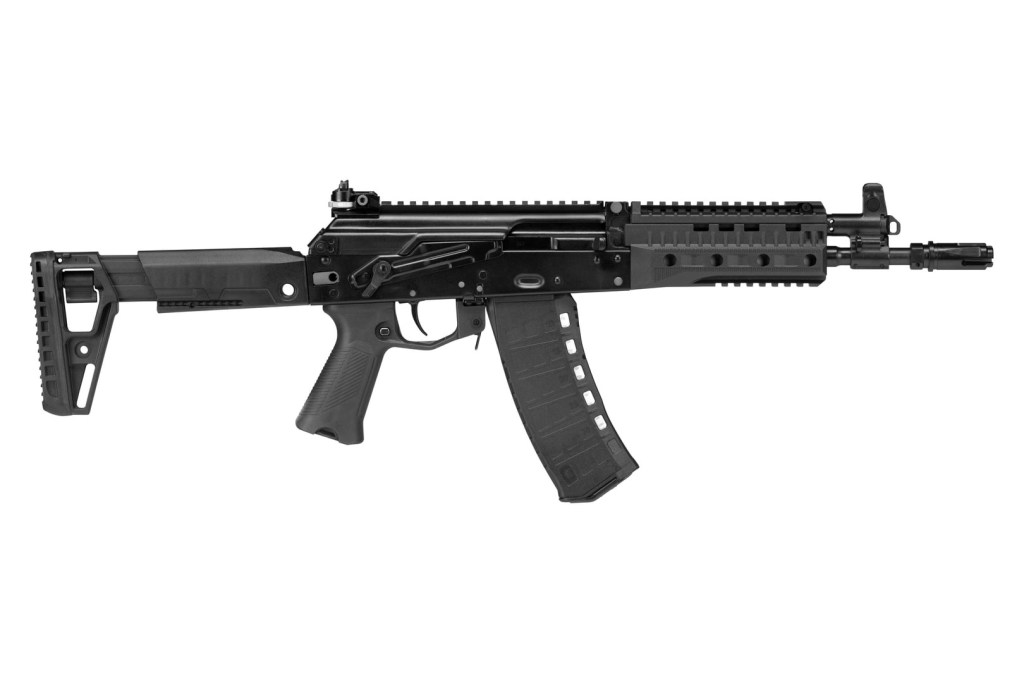
Key specs of the AK-12K (compared to AK-105):
| Feature | AK-105 | AK-12K |
| Caliber | 5.45×39mm | 5.45×39mm |
| Barrel Length | 12.5 inches (314 mm) | ~9.5–11.8 inches (varies by sub-variant) |
| Overall Length (extended) | 28.3 inches (720 mm) | ~27–29 inches (compact focus) |
| Weight (unloaded) | 3.2 kg (7 lbs) | 3.2–3.5 kg (7–7.7 lbs) |
| Rate of Fire | 600 rpm | 600–700 rpm |
| Effective Range | 400 meters | 500 meters (improved accuracy) |
| Muzzle Device | Standard flash hider | Upgraded birdcage suppressor-compatible |
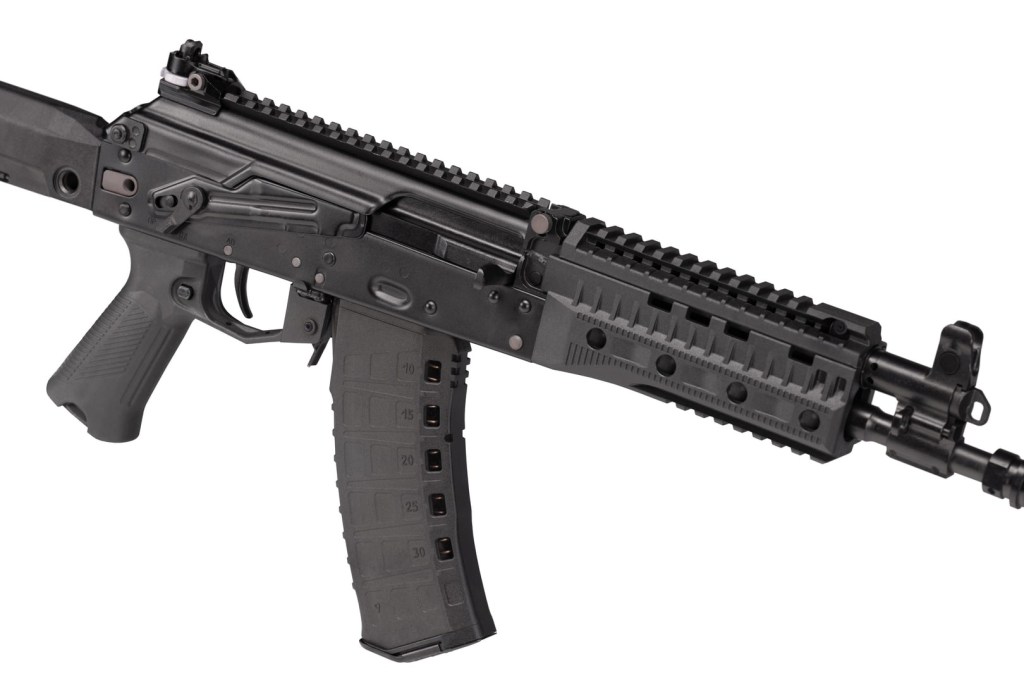
The AK-12K was prototyped around 2017 and entered limited production by 2021, with full-scale adoption accelerating in 2023–2025. It has seen combat deployment in Ukraine, where feedback led to refinements like omitting the 2-round burst mode for reliability and adding a birdcage flash hider for reduced signature. In January 2025, Kalashnikov Concern delivered the first batch of upgraded AK-12K rifles (under the AK-12M1 standard) to the Russian Armed Forces, emphasizing enhanced ergonomics, heat-resistant handguards, and modular M-LOK rails.
Other Related Variants
- AK-12SPK: An even more specialized short carbine (AK-105 length) for elite special forces, excluding burst fire and featuring aluminum upper handguards with M-LOK slots. Unveiled in 2021, it’s optimized for suppressed ops.
- AK-205: A hybrid carbine in the AK-200 export series, blending AK-100 reliability with AK-12 upgrades; used more by law enforcement than frontline troops.
The transition from AK-105 to AK-12K reflects Russia’s push toward modular, NATO-compatible designs while retaining the AK’s legendary durability. Production targets were met in 2024, with ongoing supplies ensuring widespread fielding by 2026. If you’re building one or need parts compatibility info, the AK-12K maintains much of the AK-100’s tooling for easier upgrades.
AM-17: Latest Successor to the Krinkov Lineage

AM-17 vs. NATO PDWs: Russian Compact Evolution Meets Western Armor-Piercing Specialists
The Kalashnikov Concern’s AM-17, entering serial production in 2025 as a successor to the aging AKS-74U “Krinkov,” represents Russia’s latest take on the compact assault rifle for vehicle crews, special forces, and law enforcement. Revived from a 1970s Dragunov prototype and refined through Ukraine combat trials, it prioritizes modularity, light weight, and compatibility with standard 5.45×39mm ammo over specialized PDW cartridges. In contrast, NATO’s Personal Defense Weapons (PDWs)—born from 1980s requirements to arm rear-echelon troops against body-armored threats—focus on high-velocity, low-recoil rounds like 5.7×28mm and 4.6×30mm for superior penetration at short ranges. These include the Belgian FN P90 (1990) and German HK MP7 (2001), with modern U.S. variants like the SIG MPX filling a hybrid SMG/PDW role.While the AM-17 bridges submachine gun portability with assault rifle firepower, NATO PDWs emphasize concealability, armor defeat (e.g., CRISAT targets at 200m), and minimal overpenetration in urban settings. Below, we compare the AM-17 to three iconic NATO-aligned PDWs across key metrics.
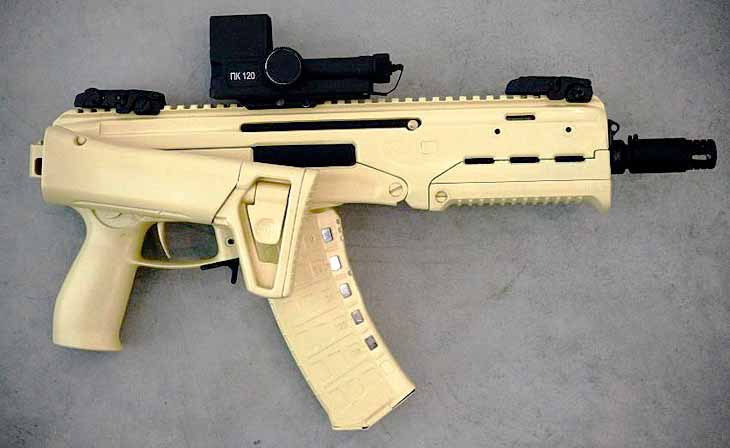
Technical Specifications Comparison
| Feature | AM-17 (Russia) | FN P90 (Belgium/NATO) | HK MP7 (Germany/NATO) | SIG MPX (USA/NATO Ally) |
|---|---|---|---|---|
| Caliber | 5.45×39mm (intermediate) | 5.7×28mm (PDW-specific) | 4.6×30mm (PDW-specific) | 9×19mm Parabellum (pistol) |
| Weight (Unloaded) | 2.5 kg (5.5 lb) | 2.54 kg (5.6 lb) | 1.9 kg (4.2 lb) | 2.7 kg (6.0 lb) |
| Length (Stock Extended/Folded) | 750 mm / 490 mm (29.5″ / 19.3″) | 500 mm / N/A (bullpup, 19.7″) | 540 mm / 340 mm (21.3″ / 13.4″) | 610 mm / 425 mm (24″ / 16.7″) |
| Barrel Length | 230 mm (9.1″) | 264 mm (10.4″) | 180 mm (7.1″) | 203 mm (8″) |
| Action | Gas-operated, short-stroke piston, rotating bolt | Straight blowback, closed bolt | Gas-operated, short-stroke piston, rotating bolt | Gas-operated, short-stroke piston, rotating bolt |
| Rate of Fire (Cyclic) | 850 rpm (±50) | 900–1,100 rpm | 950 rpm | 850 rpm |
| Magazine Capacity | 30 rounds (AK-74 compatible) | 50 rounds (top-mounted) | 20/30/40 rounds (grip-integrated) | 10/20/30/35 rounds (drum option) |
| Effective Range | 400 m | 200 m | 200 m | 100–150 m |
| Muzzle Velocity | ~900 m/s (standard 5.45mm) | 715 m/s | 720 m/s | ~380 m/s |
| Key Accessories | Full-length Picatinny rail, telescopic folding stock, ambidextrous controls | Integrated reflex sight, Picatinny rail (TR variant), laser options | Picatinny rails (top/sides), suppressor-ready | M-LOK/KeyMod rails, folding brace/stock, caliber conversion kits |
| Primary Users | Russian Army/FSB/National Guard | Over 40 NATO countries (e.g., US Secret Service) | German KSK, US SOCOM (SEAL Team 6) | US law enforcement/SOF, civilian market |
Design and Ergonomics
- AM-17: A conventional layout with polymer-heavy construction for reduced weight (7% lighter than the AKS-74U). Its side-folding telescopic stock and ambidextrous selector/charging handle enhance usability in vehicles or CQB. The Picatinny rail supports modern optics, but the 5.45mm intermediate round adds recoil compared to PDW calibers—though the short-stroke system mitigates it effectively. At 490 mm folded, it’s bulkier than true PDWs but more rifle-like for sustained fire.
- FN P90: Iconic bullpup with a top-mounted translucent 50-round magazine for low bore axis and ambidextrous operation. Fully ambidextrous and downward-ejecting, it’s ideal for left/right-handed users in tight spaces. The integrated sight and bullpup design make it ultra-compact (500 mm overall), but the unconventional ergonomics (horizontal grip, top-heavy balance) require training.
- HK MP7: The lightest and most pistol-like, with a grip-integrated magazine for a slim profile (340 mm folded). Gas-operated for reliability, it’s suppressor-ready and features side rails for lights/lasers. Ambidextrous controls shine, but the high cyclic rate demands control in full-auto.
- SIG MPX: AR-inspired modularity with familiar controls, making it intuitive for M4-trained troops. The folding brace/stock and short-stroke gas system reduce felt recoil, while caliber swaps (to .357 SIG/.40 S&W) add versatility. At 425 mm folded, it’s PDW-sized but feels more like a carbine.
Ballistics and Performance
- AM-17: Fires proven 5.45×39mm for 400 m effective range and solid barrier penetration, outpacing PDWs in velocity/energy (~1,800 J muzzle energy). However, it lacks the specialized AP performance of PDW rounds against Kevlar/Titanium (e.g., CRISAT targets), and the intermediate cartridge risks overpenetration in urban ops. Combat trials in Ukraine highlighted its reliability in mud/dust, with a 850 rpm rate for suppressive fire.
- FN P90: The 5.7×28mm SS190 round excels at armor defeat (penetrates CRISAT at 200 m) with low recoil and high capacity, but terminal ballistics on soft targets are debated—tumbling/yawing helps, yet it’s less “stopping” than 9mm. Effective to 200 m, it’s optimized for vehicle/embassy defense.
- HK MP7: 4.6×30mm DM11 penetrator matches P90 in AP (200 m CRISAT defeat) with even lower weight/recoil, delivering ~500 J energy. It’s subsonic-capable with suppressors, ideal for stealthy CQB, but range drops sharply beyond 150 m.
- SIG MPX: 9mm offers familiar logistics and better soft-target stopping power (via hollow points), but minimal AP against modern vests. Muzzle energy (~500 J) suits 100 m engagements; it’s louder/less flat-shooting than PDW calibers but excels suppressed.
Adoption and Role
The AM-17 targets Russian internal troops and armored crews, emphasizing AK ecosystem integration over niche AP. NATO PDWs like the P90/MP7 equip SOF/close protection (e.g., SEAL Team 6’s MP7 for breaching), while the MPX thrives in U.S. civilian/SWAT markets for its AR ergonomics.
Pros/Cons and Verdict
- AM-17 Pros: Affordable, long-range punch, battle-proven reliability. Cons: Heavier recoil, bulkier profile, less AP focus.
- NATO PDWs Pros: Superior concealability/armor defeat, low recoil for rapid follow-ups. Cons: Proprietary ammo hikes costs; shorter effective range.
The AM-17 wins for versatile, high-volume fire in peer conflicts, while NATO PDWs dominate asymmetric/urban scenarios where penetration trumps range. In a hypothetical matchup, the AM-17’s 5.45mm would outrange and out-energy rivals, but P90/MP7’s AP rounds could neutralize armored threats faster at CQB distances. As Russia iterates on Soviet legacies, NATO’s PDW niche endures for specialized edge cases.
…….
Thank you for reading. You can contact sales@krinkov.com with any questions or concerns.