
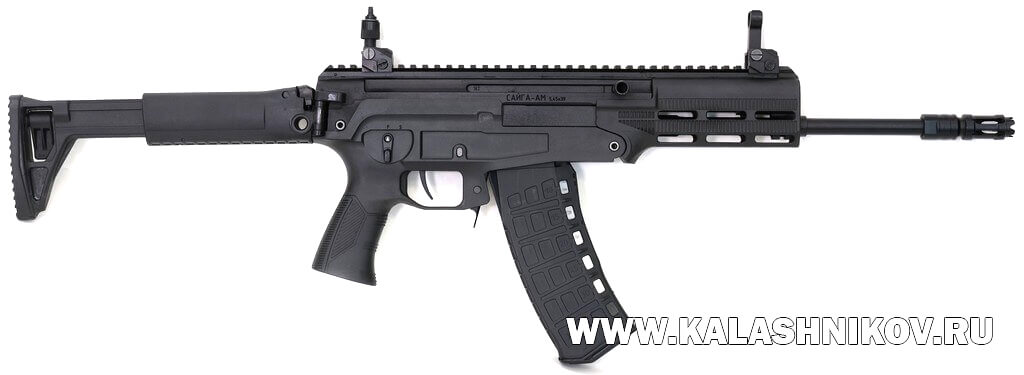
The AM-17M is an experimental full-length assault rifle variant in the ongoing development of Kalashnikov Concern’s AM-17 family. Unlike the compact AM-17 (GRAU index 6P74), which entered pilot production in September 2025 as a modern successor to the AKS-74U “Krinkov,” the AM-17M extends the platform into a standard-issue rifle role. It aims to provide a lighter, more ergonomic alternative to the AK-12 while sharing the same modular, polymer-heavy design roots from Yevgeny Dragunov’s 1970s MA prototype. As of December 2025, the AM-17M remains in prototype stages, with no confirmed adoption or production timeline, though it’s part of Kalashnikov’s broader push to create a “Russian SCAR”-like modular rifle system. Prototypes have been tested alongside the AM-17 in Ukraine’s SVO zone, focusing on reliability in extreme conditions.
Development emphasizes reduced weight (about 0.5 kg lighter than the AK-12 with a comparable barrel), improved recoil management via a short-stroke gas piston, and enhanced modularity for optics and accessories. It retains compatibility with existing 5.45×39mm ammo and AK-74 magazines, making it a cost-effective upgrade path for Russian forces.
Key Specifications
While full official specs are limited due to its prototype status, here’s a comparison based on available data against the AM-17 compact and AK-12 baseline:
| Feature | AM-17M (Prototype) | AM-17 (Compact) | AK-12 (Current Standard) |
|---|---|---|---|
| Caliber | 5.45×39mm (variants in 7.62×39mm, 5.56×45mm NATO planned) | 5.45×39mm | 5.45×39mm |
| Action | Gas-operated, short-stroke piston, rotary bolt | Gas-operated, short-stroke piston, rotary bolt | Gas-operated, long-stroke piston |
| Weight (Unloaded) | ~3.0 kg (6.6 lbs, estimated) | 2.5 kg (5.5 lbs) | 3.5 kg (7.7 lbs) |
| Length (Stock Extended) | ~940 mm (37″) | 740 mm (29.1″) | 922 mm (36.3″) |
| Barrel Length | 415 mm (16.3″) | 280 mm (11″) | 415 mm (16.3″) |
| Effective Range | 500 m | 400 m | 500 m |
| Rate of Fire | ~800 rpm | ~800 rpm | 600–700 rpm |
| Magazine Capacity | 30 rounds (AK-74 compatible) | 30 rounds (AK-74 compatible) | 30 rounds (AK-74 compatible) |
| Muzzle Velocity | ~900 m/s | ~735 m/s | ~900 m/s |
| Sights | Full-length Picatinny rail; adjustable iron | Full-length Picatinny rail; adjustable iron | Adjustable iron; optional rails |
| Stock | Telescoping, side-folding polymer | Telescoping, side-folding polymer | Telescoping polymer |
| Key Features | Ambidextrous controls; polymer receivers with aluminum/steel reinforcements; stable rail for optics; reduced recoil | Same as AM-17M but compact-focused | Traditional AK ergonomics; higher recoil |
The AM-17M’s design features a hinged upper/lower receiver for quick disassembly, ambidextrous charging handle and fire selector, and a heat-shielded handguard. Its short-stroke system minimizes bolt carrier friction, improving full-auto stability and barrel life compared to long-stroke AKs. Future variants could include civilian “hunting” models or suppressed options, expanding the family’s calibers.
Development Status and Future Prospects
- Origins: Evolved from the AM-17’s 2017 debut; full AM-17M prototypes built during 2024 state trials.
- Testing: Combat-evaluated in SVO for ergonomics and durability; refinements include better polymer composites for weight savings.
- Production: No mass rollout yet—focus remains on AM-17 batches for FSB/National Guard. Kalashnikov aims for family-wide adoption by 2030 if trials succeed, potentially replacing AK-12 in select units.
- Challenges: Must prove superior reliability in Russian army mud/sand tests; critics note it’s “innovative but late” to global trends like AR-15 modularity.
(Source: http://www.Kalashnikov.ru)
For visuals, prototypes show a sleeker profile than the AK-12, with extended barrel and rail. If adopted, it could mark a shift from Kalashnikov’s long-stroke legacy toward more Western-inspired designs.
[…] newer compact platforms like Kalashnikov’s AM-17 and PPK-20 are entering production to succeed the classic AKS-74U Krinkov, the original’s […]